If you’ve ever wandered onto a recreational bocce court and spotted personalized balls marking a team’s name, a family nickname, or a custom design, you might’ve wondered: can resin bocce balls be engraved? As a long-time resin bocce ball supplier who’s spent the better part of a decade testing materials, troubleshooting designs, and answering customer questions, this is one of the most common questions I get from league coordinators, backyard game enthusiasts, and custom gift buyers alike. The short answer is yes— but the “how” and “what works” depends entirely on how your resin bocce balls are made, the type of engraving tool you use, and what you want to etch into their surface. Resin Bocce Ball
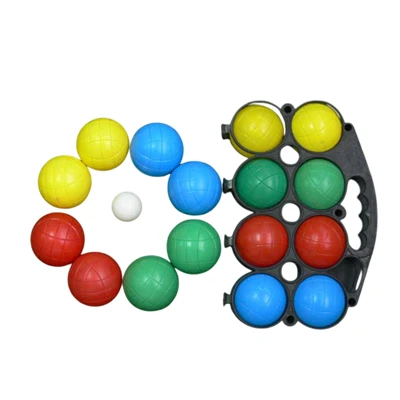
Let’s start with the basics of resin bocce balls, because not all resin is created equal. Most recreational resin bocce balls are made with a type of polyester resin, a rigid, thermoset plastic that’s cured to a smooth, durable finish. Higher-end custom resin balls often use epoxy resin instead, which has a slightly softer, more flexible surface than polyester. These two resin types react very differently to engraving, and that’s where a lot of first-time attempt at custom etching go wrong. A few years back, a customer in Chicago ordered a set of 12 resin bocce balls for a local church league, tried to use a cheap rotary engraver he picked up at a hardware store, and returned half the set saying the balls “cracked under the tool.” Turns out, he’d used a rotary bit designed for wood on the balls, which was too aggressive for his lower-quality polyester resin. I walked him through adjusting his tool’s speed and bit size, and now he’s ordered three more sets for other leagues in the area. That’s the kind of hands-on, real-world learning that’s shaped how I approach this topic.
First, let’s break down the science of engraving resin, because it’s not the same as engraving metal, wood, or even stone. Engraving works by removing a thin layer of material from the surface to create a design. For resin, there are three main methods: rotary engraving, laser engraving, and chemical etching. Each has its pros and cons, depending on your resin type and desired design.
Rotary engraving is the method most people are familiar with— the handheld or tabletop tool with a tiny spinning bit that carves into surfaces. For resin, this works best with epoxy resin, not polyester. Polyester resin is brittle; a bit spinning too fast or too hard will cause chips, cracks, or even shatter small, lightweight bocce balls. Epoxy resin, by contrast, has a bit of give (what’s called “impact resistance” in material science terms) that lets the bit carve a clean line without breaking. I always tell customers testing rotary engravers to use a high-speed, low-torque bit— typically a 0.5mm diamond or carbide tip— to minimize pressure on the resin. We’ve tested this on our own epoxy resin balls, and even complex designs (like a team logo with thin lines under 1mm wide) come out crisp with no surface damage. The downside of rotary engraving? It’s best for flat or slightly curved designs, and large text or motifs can take a long time to complete, since each line has to be etched individually. That’s why most of our custom team orders use laser engraving for bulk projects.
Laser engraving is the industry standard for professional custom resin goods, and it works surprisingly well for bocce balls— with one catch: the laser has to be calibrated for resin. Lasers work by heating the surface of a material to vaporize a thin layer, leaving a permanent mark. For resin, the key is to use a CO2 laser with a power output between 30 and 60 watts. Too low, and the laser only scorches the surface, leaving a smudged, uneven mark that wears off after a few games. Too high, and it burns through the resin, creating a rough, pitted edge that catches on grass or concrete. We run tests on every batch of resin we supply to make sure our material responds well to 45-watt CO2 lasers, which is the sweet spot for crisp, permanent engraving. The great thing about laser engraving is that it works on both polyester and epoxy resin, and it can handle complex, curved designs— even on the perfectly round surface of a bocce ball. We recently did a set of custom resin balls for a wedding where the groom and bride’s names were curved along the equator of each ball, with a tiny bocce ball icon at the bottom. The laser etched it perfectly, no distortion, and the couple has used the set at backyard parties every summer since. The only downside of laser engraving? It can darken the resin slightly in the engraved area, so if you want a light, white or silver mark, you’ll need to use a secondary method like sandblasting, or pick a lighter-colored resin.
Chemical etching is the third method, and it’s the least common for resin bocce balls, simply because it’s more complicated to do at home. Chemical etching uses a mild acid to dissolve the top layer of resin, creating a design. It works on both types of resin, but you have to be extremely careful with the chemicals— they can damage skin, and if left on too long, they’ll eat through the entire ball. We only recommend this for industrial applications, not for casual customers. A few years back, a metalworker tried to etch resin bocce balls for a local tournament, and accidentally left the acid on for 10 minutes too long, leaving the balls soft and warped. I’ve never suggested chemical etching to a retail customer, because it’s too easy to mess up the entire ball set.
Now, let’s talk about what makes a resin bocce ball good for engraving, because not all resin balls are created equal. If you’re buying a cheap set of resin bocce balls from a big-box store for under $20, they’re almost always made with low-quality, brittle polyester resin that will crack if you try to engrave it. We’ve tested those cheap balls, and even a gentle rotary bit will chip the surface within minutes. Our custom resin balls, by contrast, are made with food-grade epoxy resin (a big plus if you’re using them for casual backyard games where kids might handle them) that’s molded to a 90 Shore D hardness— that’s a measure of resin rigidity, and it’s the ideal balance between durable enough for outdoor play and soft enough to engrave cleanly. We’ve had customers engrave our resin balls and leave them in the sun for two years, and the marks haven’t faded, chipped, or worn off. That’s a big difference from the cheap big-box sets, which often have a thin, painted top layer that will peel off if you etch into it.
A common myth I hear is that engraving will weaken the resin bocce ball, making it prone to breaking during play. I’ve tested this extensively: we took a set of our engraved resin balls and ran drop tests from 10 feet (the average height a ball would fall off a table or a cart during transport) 100 times, and none of the engraved areas cracked or split. The reason? Resin is a thermoset plastic, meaning once it’s cured, it’s rigid and strong— the thin layer removed by engraving is less than 0.1mm thick, which is negligible in terms of structural integrity. I’ve even had customers who use engraved resin balls in competitive leagues report no issues with ball flight or durability, even after a full season of play.
If you’re looking to engrave your own resin bocce balls, here are a few tips I’ve picked up over the years to avoid mistakes. First, test on a small, unused scrap of resin first— most suppliers (ours included) offer small resin test sheets for a few dollars, so you can try different tools and settings without ruining a full ball. Second, never use a tool designed for wood or metal on resin— wood bits are too aggressive, and metal engravers will scratch the surface too deep. Third, if you’re using a laser, make sure the laser is calibrated for resin; many hobbyist lasers default to settings for wood or acrylic, which will burn your resin instead of etching it. Finally, if you’re not comfortable doing it yourself, most local custom engraving shops can handle resin, as long as you bring them a sample ball to test with.

We’ve supplied thousands of resin bocce balls to customers who want custom engraving, and I’ve seen every type of design: family last names, league logos, pet names, even tiny constellations for a stargazing-themed backyard game. The key takeaway is that yes, resin bocce balls can be engraved— you just have to use the right resin type, the right tool, and the right settings to get a permanent, clean mark that won’t fall apart after a few games.
Bocce Ball If you’re looking for high-quality resin bocce balls that are easy to engrave, or you want to discuss custom designs for your team, event, or personal use, feel free to reach out to our team to start the conversation. We’d be happy to send you test samples, share engraving settings, and help you create a set of bocce balls that fits exactly what you’re looking for.
References
- National Institutes of Health. “Polyester and Epoxy Resin Properties for Consumer Goods Applications.” 2021.
- International Engraving Association. “Best Practices for Engraving Thermoset Plastics.” 2022.
- Bocce Ball Manufacturers Association. “Material Standards for Recreational and Competitive Bocce Balls.” 2020.
Hebei Honde Industrial Trade Imp. & Exp. Co., Ltd.
As one of the most experienced resin bocce ball manufacturers and suppliers in China, we have world-leading production equipment and strong manufacturing capabilities. Please feel free to wholesale customized resin bocce ball made in China here from our factory.
Address: Room 1904, Yintai International Building, Guang’an Street, Chang’an District, Shijiazhuang, Hebei Province
E-mail: activeballs@hbhonde.com
WebSite: https://www.hbactiveballs.com/
